
DVIR Form: Free Printable Driver Vehicle Inspection Report (49 CFR 396.11)
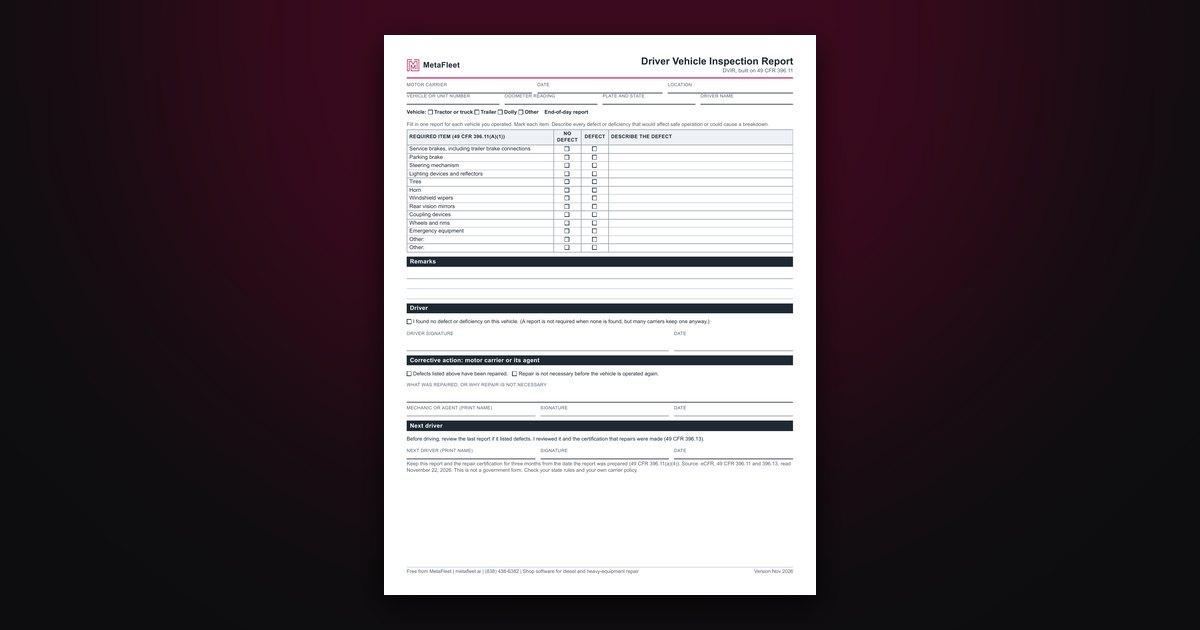
A free printable DVIR built on 49 CFR 396.11: the 11 required items, driver signature, repair certification and the retention rule, with how to fill it out.
A DVIR is the written report a driver prepares at the end of each day's work on each vehicle when a defect is found or reported. Under 49 CFR 396.11 it identifies the vehicle, lists the defect and carries the driver's signature. The carrier certifies repairs on it and keeps it three months. The free form below follows that rule.
A driver vehicle inspection report, or DVIR, is the written report a driver prepares at the end of each day's work on each vehicle when a defect is found or reported. 49 CFR 396.11 says what it has to cover. The free form below is built on that section, with the 11 required items, the driver's signature and the carrier's repair certification. It prints on one page.
This page is for fleet managers, safety leads and repair shops that hand DVIR forms to their customers. For the full rule, with the history and the electronic version, see the guide to DVIR requirements and certifying repairs.
DVIR Form
A one-page driver vehicle inspection report built on 49 CFR 396.11, with the 11 required items, the driver signature and the repair certification.
No spam. Just the occasional guide for repair shops and fleets.
The rule in brief
- One report for each vehicle, at the end of each day's work, when a defect or deficiency is found or reported.
- The driver signs it, and the carrier or its agent certifies repairs on it.
- The carrier keeps it three months.
The full rule, with who is exempt, the electronic version and what the next driver signs, is in the guide to DVIR requirements and certifying repairs.
The 11 items the report must cover
The report covers at least these parts and accessories. Each has its own line on the form, with room for the defect and for other items you add.
- Service brakes, including trailer brake connections
- Parking brake
- Steering mechanism
- Lighting devices and reflectors
- Tires
- Horn
- Windshield wipers
- Rear vision mirrors
- Coupling devices
- Wheels and rims
- Emergency equipment
Check your own state's rules
This is not a government form. The federal rule sets what the report must cover, and it does not prescribe a layout. Some states have their own inspection report rules for carriers that stay inside the state, and your customers may ask for more. Check your own state's rules and your carrier's policy before you rely on this form.
DVIR mistakes
- A driver signs a clean report without looking at the truck.
- A defect is written down, then the truck goes back out with no repair certification.
- The trailer is left off the report.
- Reports are filled in and never filed, so there is nothing to show in an audit.
- The next driver does not review the last report.
Where MetaFleet fits
MetaFleet runs digital inspections on your shop's own forms, with PM programs and reminders. See inspections and preventive maintenance for diesel shops.
Sources (4)
Rule text checked against the eCFR on November 22, 2026 (eCFR current through November 19, 2026). The last change to 396.11 and 396.13 took effect March 23, 2026.
FAQs
Ready to turn a DVIR defect into a finished repair?
See MetaFleet in Action
Book a demo and we'll walk through how a reported defect becomes a job in your shop today, show you where MetaFleet fits, and build a simple rollout plan your team can follow.
Not ready to talk? Try a free shop tool
Related Articles

DVIR Rules (49 CFR 396.11) and How to Certify Repairs
What 49 CFR 396.11 asks of drivers, carriers and the shops that fix their trucks: who prepares a DVIR, what it must cover, the no-defect rule as written today, how to certify repairs, how long records are kept, and what your paperwork should show.
49 CFR Part 396 Explained for Repair Shops
A plain-language tour of the federal inspection, repair and maintenance rule for shops that work on fleet trucks: what each section of Part 396 asks, what the carrier owns, what the shop does, and the records a shop should hand back.