
DOT Annual Inspection Checklist (49 CFR 396.17) and Who Can Perform It
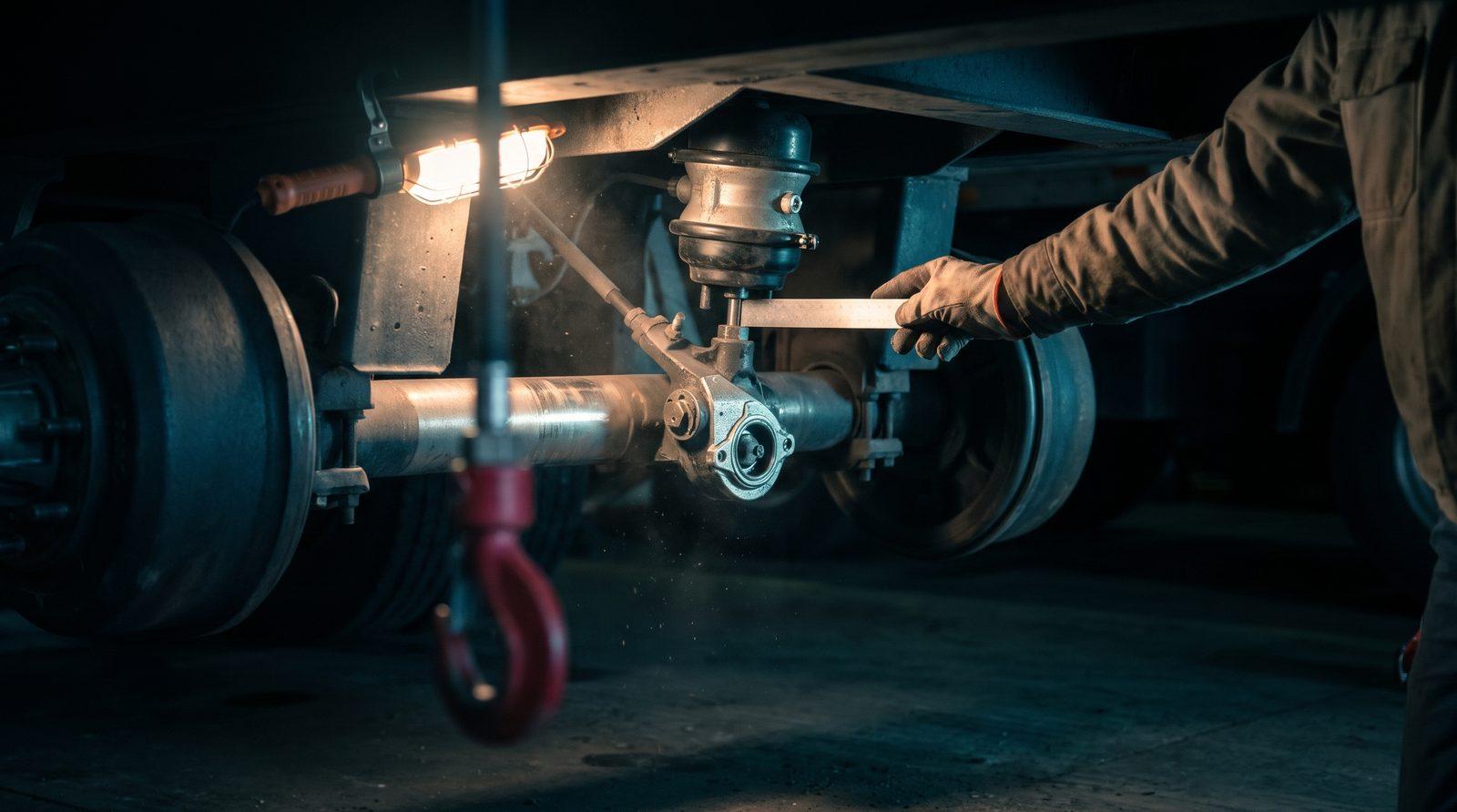
Appendix A to Part 396 as a working checklist, group by group, plus who qualifies to inspect under 396.19, the separate rules for brake inspectors under 396.25, what goes on the report and the decal, and how often each unit needs one.
Every commercial truck, trailer and converter dolly in interstate service must pass an inspection to Appendix A of Part 396 at least once every 12 months (49 CFR 396.17). The carrier's qualified inspector or a qualified shop acting as its agent can do it. The inspector certifies a report, the carrier keeps it 14 months, and proof rides on board.
This guide is for diesel and heavy-equipment shops that perform DOT annual inspections for fleets, and for fleet maintenance managers whose own techs do them. It turns Appendix A to Part 396 into a working checklist and covers who may sign, using the eCFR text as of November 19, 2026.
It's general information, not legal advice. Carriers should check the current rule and their own obligations. For the rest of Part 396, see 49 CFR Part 396 explained for repair shops, and for repairs drivers report between annuals, DVIR rules and certifying repairs.
How often: once every 12 months, per unit
A carrier may not use a commercial motor vehicle unless each Appendix A component "has passed an inspection in accordance with the terms of this section at least once during the preceding 12 months and documentation of such inspection is on the vehicle" (396.17(c)). Every unit counts: "the tractor, semitrailer, and the full trailer (including the converter dolly if so equipped) must each be inspected" (396.17(a)).
State program inspections count for 12 months "commencing from the last day of the month in which the inspection was performed" (396.17(f)). For counting the 12 months on other inspections, and why a roadside Level I doesn't count, see our DOT inspection requirements guide.
The checklist: Appendix A in plain words
"A vehicle does not pass an inspection if it has one of the following defects or deficiencies." Mark each line OK, failed or not applicable, and record the repair date for anything that failed. Below are the main fail points in each group; the full text has every line and the brake stroke tables.
1. Brake system
- No braking action on an axle that needs brakes, or a missing brake.
- Missing or broken brake parts (shoes, linings, pads, springs, anchor pins, spiders, cam rollers, pushrods, chamber mounting bolts); loose chambers, spiders or cam shaft brackets; an audible air leak at a chamber.
- Pushrod stroke over the readjustment limit (Appendix A tables and 393.47(e)), measured engine off, 80 to 90 psi, brakes fully applied.
- Linings loose or soaked with oil, grease or brake fluid, or under 1/4 inch at the shoe center on air drum brakes, or under 1/8 inch on air disc brakes. Hydraulic and electric brakes have their own limits.
- Mismatched chamber sizes or slack adjuster lengths across a power unit's steer axle; a parking brake that doesn't apply; drums or rotors with cracks that open under braking (not heat checks) or pieces missing.
- Hoses or tubing leaking, bulging, crimped, cracked, damaged through the outer ply or badly spliced.
- Low air warning missing or not working at 55 psi and below (or half the governor cut-out, whichever is less); tractor protection valve missing or inoperable; compressor belts, mounts or pulley failing.
- Electric, hydraulic and vacuum brake faults, including a missing breakaway device or a master cylinder under 1/4 full.
- ABS: malfunction lamp parts missing, lamp not lighting at power-up or staying on, or other ABS parts missing or inoperative (by build date).
- Automatic slack adjusters not holding the maker's stroke limit, replaced with manual ones, or damaged. "It is not acceptable to manually adjust automatic brake adjusters without first correcting the underlying problem."
2. Coupling devices
- Fifth wheel: missing or ineffective mounting fasteners, cracked welds or metal, over 3/8 inch play at the pivot bracket pin or slider, over 1/2 inch horizontal play between upper and lower halves, handle not locked, kingpin not engaged, or daylight between the couplers.
- Pintle hooks, drawbar eyes and tongues: cracks, any welded repair to the pintle hook, horn or eye worn more than 20%, or over 1/4 inch slider or subframe play.
- Safety chains and cables: missing, worn, kinked, or repaired with welding, wire, small bolts, rope or tape.
- Saddle-mounts: loose, cracked, or over 1/4 inch play between halves.
3. Exhaust and 4. Fuel
- An exhaust leak forward of or directly below the cab or sleeper, or exhaust placed where it could burn wiring, the fuel supply or anything combustible. Buses have extra limits.
- A visible fuel leak anywhere, a missing filler cap, or a tank not securely attached.
5. Lighting and 6. Safe loading
- Any lamp or reflector Part 393 requires that doesn't work.
- A spare tire, load or dunnage that could fall onto the road; no front-end structure where one is required; damaged or missing container securement on intermodal equipment.
7. Steering mechanism
- Free play over the limit (engine running on power steering): 16-inch wheel, 2 inches manual or 4 1/2 power; 18-inch, 2 1/4 or 4 3/4; 20-inch, 2 1/2 or 5 1/4; 22-inch, 2 3/4 or 5 3/4.
- Loose column U-bolts, worn or repair-welded U-joints, or a loose steering wheel.
- Any crack or obvious welded repair on the front axle beam or steering parts; loose or missing gear box bolts; a loose pitman arm.
- Over 1/4 inch of non-rotational play at a linkage joint, loose tie rod or drag link clamps, or loose or missing nuts.
8. Suspension and 9. Frame
- U-bolts, spring hangers or axle positioning parts cracked, broken, loose or missing so the axle shifts.
- Broken or missing leaves, a broken main leaf, coil spring or torsion bar, or a deflated air suspension.
- Torque, radius or tracking parts cracked, loose, broken or missing.
- Frame members cracked, broken, loose or sagging; loose or missing fasteners on the engine, transmission, steering gear, suspension, body or fifth wheel; body or frame touching a tire; sliding subframe pins not engaged.
10. Tires
- Steer tires on a power unit: under 4/32 inch on any major tread groove; regrooved (except vehicles used solely in urban or suburban service); a boot, blowout patch or other ply repair.
- All other tires: under 2/32 inch on any major tread groove.
- Any tire: ply or belt showing; tread or sidewall separation; flat or leaking; over its load limit, including from low pressure; touching the vehicle; marked not for highway use.
11. Wheels and rims
- Bent, cracked, sprung or mismatched lock or side rings; cracked wheels or elongated bolt holes; loose, missing or stripped fasteners; cracked welds; welded repairs on steer wheels (other than the disc-to-rim weld on steel).
12 to 15. Glass, wipers, seats and rear impact guard
- Windshield cracks, discoloration or vision-reducing matter outside a 2-inch top border, 1-inch side borders and the area below the top of the steering wheel, beyond what's allowed (a crack up to 1/4 inch wide that no other crack crosses; a spot up to 3/4 inch across, at least 3 inches from the next).
- An inoperative wiper on a power unit.
- A motorcoach passenger seat not securely fastened.
- Rear impact guard on trailers of 10,001 lb GVWR or more built on or after January 26, 1998: missing, loose, more than 22 inches off the ground, more than 12 inches forward of the rear, or not within 4 inches of each side. Other vehicles have looser limits in the full text.
To plan annuals and PM across a fleet, try the free DOT Inspection & PM Planner.
Who can perform it
The carrier's own qualified inspector (396.17(d)), or "a commercial garage, fleet leasing company, truck stop, or other similar commercial business" acting as its agent, if it "operates and maintains facilities appropriate for commercial vehicle inspections" and employs qualified inspectors (396.17(e)). Mobile shops should read the open question on facilities in our DOT inspection requirements guide first.
Inspector qualifications (396.19)
Under 396.19(a), the inspector must understand Part 393 and Appendix A, identify defective components, and have mastered the methods, tools and equipment. They also need one of these:
- a completed Federal- or State-sponsored training program, or a State or Canadian Province certificate for commercial vehicle safety inspections; or
- at least 1 year of training or experience, combined, from a vehicle maker's or similar commercial training program, or work as a mechanic or inspector in a carrier's maintenance program, at a commercial garage or fleet leasing company, or as a government CMV inspector.
The carrier keeps evidence of each inspector's qualifications while they inspect for it and for 1 year after (396.19(b)).
The ATA training exemption. Through January 15, 2030, a training program can stand in for the 1-year route, for annual inspectors and brake inspectors (90 FR 4830). It must self-certify with ATA that it follows TMC Recommended Practices and give at least 540 hours of classroom and hands-on instruction, or 210 hours for people who already have 330 hours of classroom and hands-on experience and have passed the ASE T4 and T8 tests. The carrier checks that the program was on ATA's list on the certificate date, and still keeps the evidence.
Brake inspectors (396.25)
A brake inspector is "any employee of a motor carrier or intermodal equipment provider who is responsible for ensuring that all brake inspections, maintenance, service, or repairs" meet federal standards (396.25(b)). They must understand and be able to do the task, have mastered its methods and tools, and have either (396.25(d)):
- a State, Provincial, Federal or labor union apprenticeship, an agency-approved training program, or a State or Province certificate for the task (for brake inspections, that includes passing the CDL air brake tests); or
- at least 1 year of brake-related training or experience, from a brake or vehicle maker's or similar training program, or brake work in a carrier's maintenance program or at a commercial garage or fleet leasing company.
The carrier keeps the evidence while they're in the job and for 1 year after, except for air brake inspections by someone who passed the CDL air brake knowledge and skills test (396.25(e)). The definition names the carrier's employees, but the carrier must make sure all brake work on its vehicles meets the section (396.25(a)). Our reading: expect fleets to ask for your techs' brake records.
The record and the decal
The inspector prepares and certifies the report (396.21(a)), and the carrier or other responsible entity keeps it 14 months (396.21(b)). Our DOT inspection requirements guide lists what the report must contain. Proof on the vehicle can be the report or a decal showing (396.17(c)(2)):
- the date of inspection;
- the name and address of the carrier, provider or other entity where the report is kept;
- information identifying the vehicle, if it isn't clearly marked;
- a certification that the vehicle passed an inspection under 396.17.
FMCSA's example annual inspection report has OK, needs repair and repair date columns, but no lines for the rear impact guard or motorcoach seats. Add them if you build from it.
Before you sign
- Find the cause of any out-of-adjustment automatic slack adjuster before you adjust it.
- Sign for what you inspected: the report certifies "the accuracy and completeness of the inspection" (396.21(a)(6)).
- Fix failed items before the decal goes on. The decal certifies the vehicle passed.
Where MetaFleet fits
MetaFleet runs digital inspections on your shop's own forms, so your annual inspection checklist stays your form, and techs fill it in from any phone browser. PM programs and reminders keep each truck's next service in view. Fleet customers can request inspections and repairs through the customer portal and approve each repair on the estimate from a link. The inspection and the signature stay with your qualified inspector.
See inspection and preventive maintenance software for diesel shops, or book a demo.
Sources (7)
Rule text checked against the eCFR on November 19, 2026 (eCFR current through November 18, 2026). Appendix A was last amended September 29, 2022, and 396.17, 396.19 and 396.21 on October 14, 2021.
- eCFR: Appendix A to Part 396, minimum periodic inspection standards
- eCFR: 49 CFR 396.17, periodic inspection
- eCFR: 49 CFR 396.19, inspector qualifications
- eCFR: 49 CFR 396.21, periodic inspection recordkeeping requirements
- eCFR: 49 CFR 396.25, qualifications of brake inspectors
- Federal Register: 90 FR 4830 (Jan 16, 2025), ATA inspector qualification exemption, through Jan 15, 2030
- FMCSA: example annual periodic vehicle inspection report (PDF)
FAQs
Ready to run annual inspections on your own forms?
See MetaFleet in Action
Book a demo and we'll walk through how your shop runs DOT annual inspections today, show you where MetaFleet fits, and build a simple rollout plan your team can follow.
Not ready to talk? Try a free shop tool
Related Articles
49 CFR Part 396 Explained for Repair Shops
A plain-language tour of the federal inspection, repair and maintenance rule for shops that work on fleet trucks: what each section of Part 396 asks, what the carrier owns, what the shop does, and the records a shop should hand back.

DVIR Rules (49 CFR 396.11) and How to Certify Repairs
What 49 CFR 396.11 asks of drivers, carriers and the shops that fix their trucks: who prepares a DVIR, what it must cover, the no-defect rule as written today, how to certify repairs, how long records are kept, and what your paperwork should show.