
Trailer Inspection Checklist: Free Printable for Dry Van, Reefer, Flatbed, Tanker and Dump Trailers
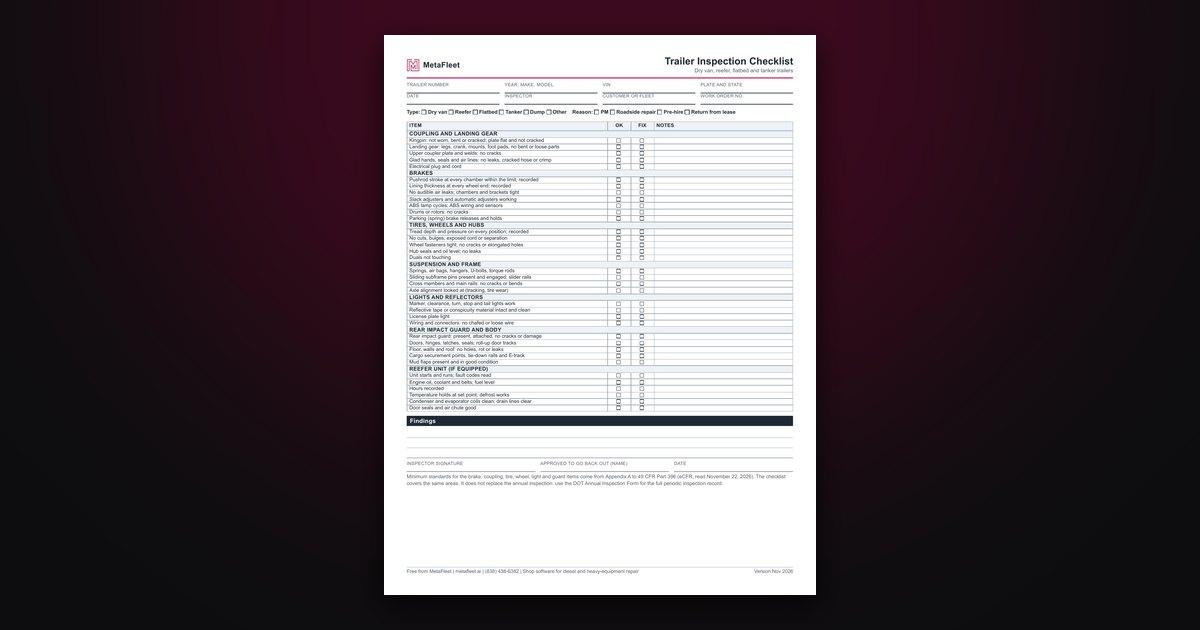
A free printable trailer inspection checklist covering the kingpin, brakes, tires, lights, rear impact guard, body and reefer unit, with a findings box and sign-off.
A trailer inspection checklist covers the coupling and landing gear, brakes, tires and wheels, suspension and frame, lights and reflectors, rear impact guard, body and the reefer unit if there is one. The free printable below has a line for each, a findings box and a sign-off, and fits one page.
A trailer inspection checklist is the sheet a tech or driver uses to go over a trailer from the kingpin to the rear doors. The free printable below fits one page and works for dry van, reefer, flatbed, tanker and dump trailers.
This is for shops that inspect and repair fleet trailers and for fleets that look after their own. It is the working checklist for a PM, a pre-hire check or a return from lease. For the full periodic inspection record that 49 CFR 396.21 requires, use the DOT annual inspection form.
Trailer Inspection Checklist
A one-page checklist for dry van, reefer and flatbed trailers: coupling, brakes, tires, suspension, lights, rear impact guard, body and the reefer unit.
No spam. Just the occasional guide for repair shops and fleets.
What is on the checklist
| Section | What to check |
|---|---|
| Coupling and landing gear | Kingpin and plate, landing gear legs and crank, glad hands, air lines, electrical plug |
| Brakes | Pushrod stroke and lining thickness at every wheel end, air leaks, adjusters, ABS lamp, drums or rotors, spring brake |
| Tires, wheels and hubs | Tread depth and pressure at every position, cuts and bulges, wheel fasteners, hub seals |
| Suspension and frame | Springs or air bags, hangers, torque rods, sliding subframe pins, rails and cross members |
| Lights and reflectors | Marker, clearance, turn, stop and tail lights, reflective tape, wiring |
| Rear impact guard and body | Guard attached and undamaged, doors, floor, walls, roof, tie-down points, mud flaps |
| Reefer unit | Starts and runs, oil, coolant, belts, fuel, hours, temperature and defrost, coils and drains |
Where the brake, coupling and guard items come from
Appendix A to 49 CFR Part 396 lists the defects that fail a commercial vehicle at its annual inspection, including trailer brakes, coupling devices, tires, wheels, lights and the rear impact guard. The checklist uses the same areas so the checklist covers the same areas. It does not replace the annual inspection. Write the actual readings down. A pushrod stroke over the limit for the chamber fails, and you can only see the trend if the number was recorded last time. See Appendix A to Part 396 and slack adjuster in the shop glossary.
Reefer units
A reefer trailer is two machines: the trailer and the refrigeration unit. The unit has its own engine hours, service interval and fault codes, so it has its own section. Record the hours at every visit. For a shop that works on reefer units on the road, see mobile reefer repair software.
Check your own state's rules
This is a working checklist, not a government form. Your state, your customer and your insurer may have their own inspection rules. Check them before you rely on this form.
Trailer inspection mistakes
- Checking the tractor brakes and skipping the trailer's.
- No pushrod stroke or lining measurement written down.
- Faded reflective tape and a bad plug passed because the lights worked once.
- A cracked or loose rear impact guard left for later.
- No hours recorded for the reefer unit.
Where MetaFleet fits
MetaFleet runs digital inspections on your shop's own forms, with PM programs and reminders. See inspections and preventive maintenance for diesel shops.
Sources (2)
Rule text checked against the eCFR on November 22, 2026 (eCFR current through November 19, 2026).
FAQs
Ready to track every trailer's inspections in one place?
See MetaFleet in Action
Book a demo and we'll walk through how you track trailer inspections and repairs today, show you where MetaFleet fits, and build a simple rollout plan your team can follow.
Not ready to talk? Try a free shop tool
Related Articles
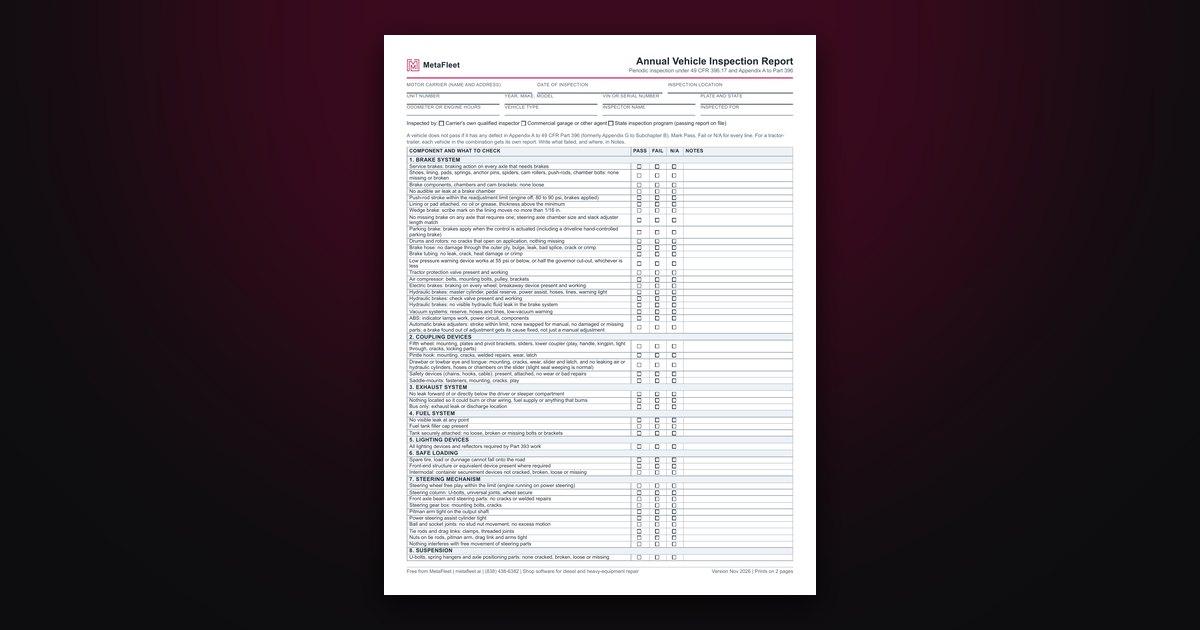
DOT Annual Inspection Form: Free Printable Periodic Inspection Report (49 CFR 396.17)
A free printable DOT annual inspection form that covers the 15 groups in Appendix A to Part 396 and the report contents 49 CFR 396.21 requires.

Semi Truck PM Service: What's in PM A, B and C, a Checklist, and What Drives the Cost
What PM A, B and C mean for a semi truck, an example checklist for each level, how to set intervals from the makers' schedules, and what makes one PM cost more than another, for shops and fleets.